
For the last few years of my life, meditation lived in the realm of feeling.
You sit. You breathe. You drop in. Something softens. Your thoughts slow, your body settles, and there’s this beautiful spaciousness that opens up. And yes — something shifts. You can feel it.
But if you’re being really honest with yourself? There’s often this quiet question humming underneath it all:
Is something actually happening… or am I just getting better at being still?
That question didn’t create doubt for me — it created curiosity. And that curiosity is what led me deeper into my practice, not away from it. I didn’t want to replace meditation. I wanted to understand it. Track it. Explore whether the internal shifts I was experiencing had any kind of measurable relationship to the world around me.
That’s what eventually led me to the Egely Wheel.
What Is the Egely Wheel?
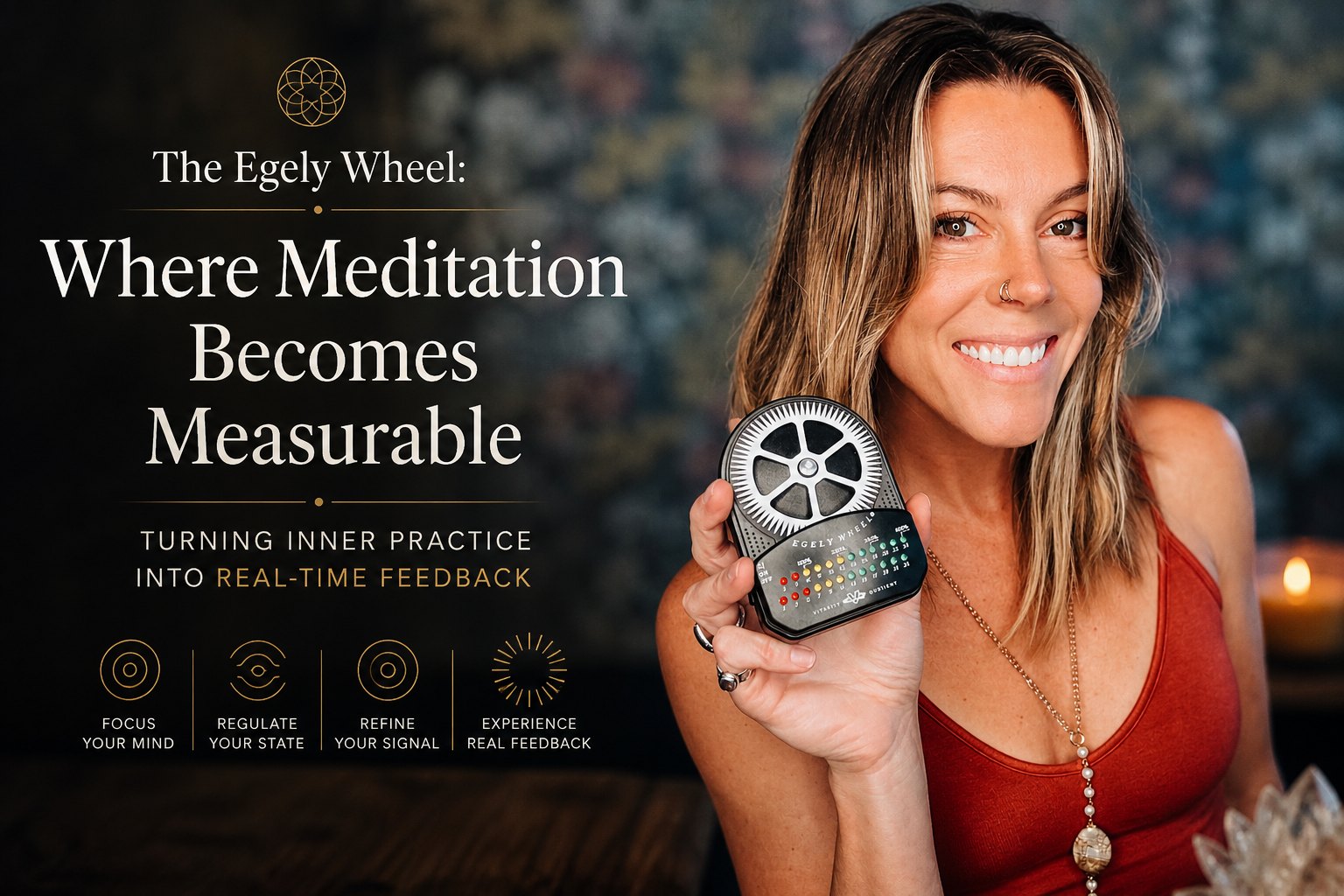
The Egely Wheel is a small, lightweight device developed by Hungarian scientist Dr. György Egely — a physicist and researcher who spent decades studying human bioenergy. At its center is a delicate wheel, balanced on a needle-thin point, designed to respond to the subtle bioelectric and thermal energy emitted from the human body. You place your hands near it — not touching it — and watch what happens. Or doesn’t happen.
It sounds simple. And in some ways it is. But what it reveals about your internal state is anything but.
The first thing that really pulled me in was the 2025 Psi Games psychokinesis competition. Something about it immediately sparked that feeling I know so well: I need to try this for myself.
Not in a “this must be real” kind of way — more like a genuine, wide-open curiosity.
Could I actually influence something external with my focus? Could my internal state — my attention, my energy, my breath — create a visible response?
Not as a concept. Not because someone told me to believe it.
But as something I could sit down with and test in real time.
So I did.
And what I expected to be about “moving a wheel” very quickly became something completely different. It stopped being about the object in front of me and started being about what was happening within me. It became a process of observation, refinement, and sensitivity — a kind of self-study that was more honest than anything I’d experienced before, because the feedback wasn’t coming from my interpretation. It was coming from the system itself.

Save $50 with Discount Code:
THEWILDAURA50
The Science Underneath the Spiritual
Here’s what I came to understand through consistent practice, and I really want you to sit with this:
This isn’t about “energy” in the way most people think. It’s not abstract. It’s not separate from your body. It’s not some mystical gift you either have or you don’t.
It’s deeply physiological.
Your body is electrical. Your nervous system is constantly regulating, signaling, and adapting. Your attention has direction. Your breath has rhythm. Your internal state is always organizing — or disorganizing — your system in subtle but very real ways.
What tools like the Egely Wheel do is give you a way to see that organization reflected back at you.
Not as a belief. As feedback.
The Moment Everything Shifted for Me
Something really important happened when I started working with it consistently.
Meditation stopped being just about how I felt… and started becoming about what my state was actually producing.
There were moments where I felt calm, relaxed, even peaceful — and nothing happened. No response. No movement. And then there were other moments where I felt almost neutral, but internally clear — and the system responded immediately.
That’s when I understood: relaxation and coherence are not the same thing.
And coherence? Has a signature.
Let’s Talk About “Building Chi”
Here’s the thing — humans have known about this energy for a very long time. We just haven’t always called it the same thing.
In Traditional Chinese Medicine, it’s chi (or qi) — the vital life force that flows through meridian pathways in the body, animating every organ, every system, every breath. The ancient Chinese understood that when chi flows freely, you have health, clarity, and vitality. When it stagnates or depletes, that’s when disease, fatigue, and disconnection set in. Practices like Qi Gong and Tai Chi were built entirely around the cultivation, circulation, and storage of this energy.
In the Indian yogic tradition, they called it prana — the animating breath-force that moves through channels called nadis. Pranayama, the breathwork practices woven into yoga, are essentially a technology for building and directing pranic energy throughout the body.
The Japanese called it ki. The Polynesians, mana. Ancient Egyptians referenced ka. The Hebrews, ruach. Even the ancient Greeks had pneuma — the vital spirit carried on the breath.
Different languages. Different maps. The same territory.
What strikes me most is that these weren’t just spiritual metaphors — these were sophisticated, embodied systems developed over thousands of years of careful observation of the human body and its relationship to life force. They were tracking something real.
And modern science is starting to catch up. Because what these traditions were describing — this flowing, buildable, directable energy — maps remarkably well onto what we now understand about the body’s bioelectric field, the nervous system, and the fascia network that runs through every inch of us.
Which brings me to where I am right now in my own practice.
Lately I’ve been going deep into the yin and yang framework of chi — and it’s genuinely changed how I work with my own energy. In TCM, yin chi is receptive, cooling, restorative. It’s the energy you store — the deep reserves held in the organs, particularly the kidneys. Yang chi is active, warming, expressive. It’s the energy you move and project outward.
Most of us in modern life are chronically yang-dominant. We’re always outputting — giving, doing, pushing, performing. And we rarely stop to actually replenish the well.
What I’ve been learning is that building chi isn’t just about generating more energy. It’s about creating the conditions for energy to accumulate, refine, and deepen. That means consciously cycling between yin and yang states — between stillness and movement, reception and expression, rest and activation.
And here’s where it gets really fascinating from a physiological standpoint: this kind of intentional, consistent practice actually appears to develop the nerve fiber endings — the subtle sensory network throughout the body that registers energetic signals. Think of it like upgrading your internal antenna. The more you work with chi deliberately, the more sensitive your system becomes to detecting it, directing it, and ultimately outputting it with greater precision and power.
I’ve felt this directly. There’s a palpable difference in my hands now compared to when I first started. A warmth, a density, an awareness of something moving that I can direct with intention. It’s not imagination — it’s developed sensitivity. And the Egely Wheel has been one of the ways I’ve been able to see that development reflected back to me in real time.
That’s what chi is, to me.
Not something you force. Not something you project from ego.
Something you cultivate — through patience, through practice, through learning to balance what you build with what you store.
And the Egely Wheel becomes a mirror for exactly that.

Here’s the Humbling Part Nobody Talks About
One of the most grounding realizations of this entire practice? Effort doesn’t work here — at least not the way we’ve been conditioned to apply it.
Trying harder doesn’t create better results. If anything, it introduces more interference. More tension. More noise in the system.
The moments that create the clearest response are almost always the ones where there’s less trying and more allowing. Less pressure, more presence. A softened focus. A genuine curiosity about what’s happening rather than a need to make something happen.
It becomes less about control, and more about relationship.
And that shift? It changes everything.
The Real Gift: Radical Honesty with Yourself
What this practice gives you, more than anything else, is honesty.
Because the system doesn’t respond to what you think you’re doing — it responds to what’s actually happening within you.
Every moment becomes information.
If nothing happens, that’s information. If something shifts, that’s information. There’s no success or failure here — just data. And the more willing you are to observe that data without attaching a story to it, the more refined your awareness becomes.
You stop guessing.
You start noticing.
And over time, that sensitivity builds into something incredibly valuable — because it stops being about the wheel entirely.
You begin to recognize your own state in real-world situations. You feel when your system is regulated… and when it’s not. You notice how your presence affects people around you. How your clarity sharpens your perception. How your body responds under pressure.
You start to understand that your internal state isn’t isolated — it’s participatory. It’s constantly interacting with your environment in ways that are subtle, but undeniably real.
And once you can feel that clearly? You’re no longer operating from assumption.
You’re working from awareness.
Why I Use It the Way I Do
This is why the Egely Wheel has become part of my practice — not as a performance, not as something to prove, and not even as the goal itself.
But as a tool. For developing sensitivity. For refining internal awareness. For learning how to stabilize my system and observe how that stability translates into the world around me.
It brings meditation out of the abstract and into lived experience.
And for me? That’s where things actually start to get interesting.
Because when you can feel your own signal clearly…
You’re no longer guessing what’s happening.
And that’s when the real work — and the real magic — begins.

Want to Go Deeper?
If this resonates with you, here are two ways to keep exploring:
🌀 Human Resonance Mechanics — 3-Day Workshop This is where we go all the way in. Over three days, we work directly with the principles behind energy coherence, nervous system regulation, and developing your sensitivity as a real, trainable skill. If you’ve been feeling called to understand your own energy on a deeper level — this is it. Use code EARLYBIRD to save $150 off (offer expires 5/15/26). 👉 Join the Human Resonance Mechanics Workshop
⚙️ Get Your Own Egely Wheel If you want to start exploring your own energy output and build the kind of real-time feedback practice I described in this post, I highly recommend getting your hands on an Egely Wheel. It’s one of the most honest and fascinating tools I’ve added to my practice. 👉 Explore the Egely Wheel here — and use code THEWILDAURA50 to save $50 on your order.
Your body already knows things your mind is still trying to catch up to. Sometimes all it takes is the right tool — and the right community — to help you start seeing it clearly.
Leave a Reply